A Plain-English Guide to Filing Your VAT Return
“Would 100% recommend, is always polite, professional and helpful! He is always available to answer any questions I have and his knowledge has been a saving grace many times!”
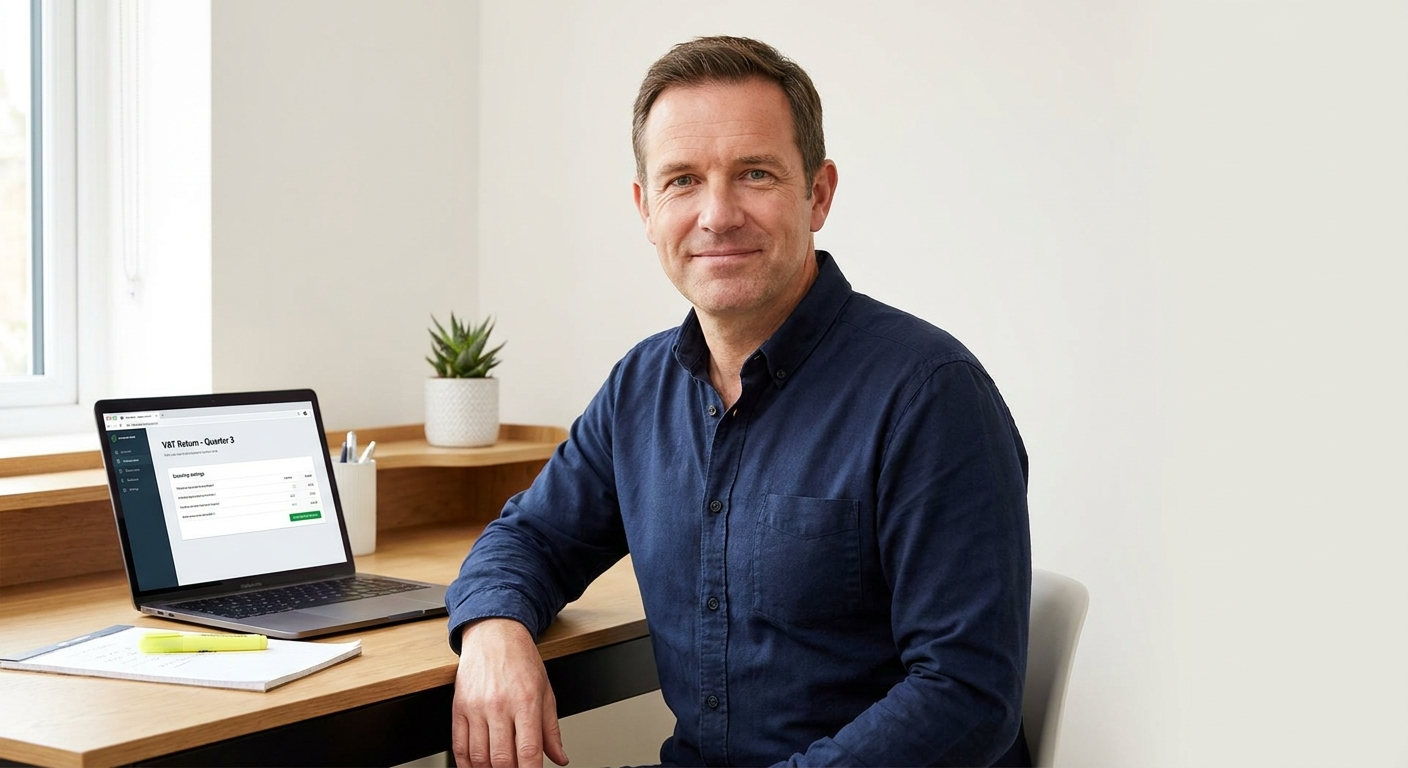
If you are VAT-registered and you are finding the quarterly process stressful, time-consuming, or just plain confusing, you are not alone. This guide covers exactly what goes into a VAT return, where most small business owners go wrong, and what your options are for getting it handled correctly every time.
Why getting your VAT return right matters
Once you cross the VAT registration threshold, HMRC requires you to report your total sales, total purchases, VAT owed, VAT reclaimable, and any VAT owed back to you on every return. That sounds manageable until you factor in mixed-rate sales, reclaim rules, import VAT, and the requirement to include VAT on the full value of sales even when no VAT was charged. Miss a detail and you are filing an inaccurate return.
The consequences are real. HMRC can charge a penalty of up to 100% of any tax under-stated or over-claimed on an inaccurate return. A penalty of that scale can seriously hurt a small business. Filing accurately, every quarter, is not optional.
Since April 2022, all VAT-registered businesses must file under Making Tax Digital for VAT. This means you are legally required to keep digital records and submit returns using MTD-compatible software that communicates directly with HMRC via API. Spreadsheet-to-portal filing is no longer compliant. Source: VAT Notice 700/22, GOV.UK.
Where most people go wrong with VAT returns
In seven years of working with sole traders, limited companies, and contractors across the UK, I see the same errors come up repeatedly. The good news is that most of them are avoidable once you know what to look for.
Miscategorising transactions
Standard-rated, zero-rated, reduced-rated, and exempt supplies are all treated differently on a VAT return. Putting a zero-rated sale into the standard-rated box, or vice versa, distorts both your VAT liability and your reclaim. This is one of the most common reasons a return produces a figure that does not match a business owner’s expectations.
Missing the MTD software requirement
Under MTD for VAT, your software must keep digital records, prepare the return, and communicate with HMRC via API. Some business owners are still copy-pasting figures manually into the portal, which does not satisfy this requirement. If your software does not have a direct HMRC connection, your filing method may not be compliant, regardless of whether the figures are correct.
“Most clients who come to me for VAT are spending six to ten hours a quarter on returns they are not fully confident in. Once I take it over, that time goes back to them and the anxiety about getting it wrong goes away. That trade-off is usually obvious within the first quarter.”
What to do, step by step
Filing a VAT return accurately requires the same disciplined process every quarter. Here is the practical sequence that works for the small businesses I work with.
- Reconcile your transactions in your accounting software before the return period closes. Every sale and every purchase should be categorised correctly, with the right VAT treatment applied. Check that bank transactions match your records. If you use QuickBooks, FreeAgent, Xero, or Sage, the categorisation work should already be done inside the software throughout the quarter, not in a rush at deadline.
- Review the nine VAT return boxes before submitting. Box 1 is VAT due on sales. Box 4 is VAT you are reclaiming on purchases. Box 6 and Box 7 are net values of sales and purchases respectively. Each figure should be traceable back to your records. If any box produces a number that does not feel right, investigate the source data before filing.
- Submit using MTD-compatible software by your deadline, typically one calendar month and seven days after the end of your VAT period. Keep a record of your submission confirmation. If you are entitled to a repayment, HMRC will process this separately. Monitor the VAT online service status page around your deadline, as planned maintenance windows do occasionally coincide with filing periods.
One thing worth knowing: if you have any bad debts older than six months that meet HMRC’s conditions, you can claim relief on those through your VAT return. It is a legitimate reclaim that many small businesses overlook.
Costs and what to expect
The real cost of DIY VAT is rarely just the filing fee. It is the hours spent each quarter reconciling figures, the risk of a penalty for an inaccurate return, and the ongoing effort of keeping up with rule changes like MTD. When I take on a client’s VAT returns, that responsibility shifts to me entirely. I handle the reconciliation, the review, and the submission. My fees are fixed, so there are no surprise charges at the end of the quarter.
| Approach | Pros | Cons |
|---|---|---|
| Filing it yourself | No accountancy fee | Time-consuming each quarter, higher risk of errors, penalties up to 100% of under-stated tax |
| Using an accountant | Accurate filing, MTD compliance covered, and your time back | Monthly or quarterly fee, requires access to your software or records |
How to get started today
If your next VAT deadline is approaching and you want someone to take this off your plate, the process of handing it over is straightforward. I work remotely with clients across the UK, so location is not a factor. I use QuickBooks, FreeAgent, Xero, and Sage, so whatever software you are already on, I can work within it.
- Book a free introductory call at /contact. Tell me your VAT period, your current software, and roughly how many transactions you process each quarter. I can confirm whether I can take on your next return and give you a fixed fee.
- If you are already behind or facing an upcoming deadline within the next two weeks, mention that on the call. I will tell you honestly what is achievable and what you need to provide. I have seen records in all conditions and will give you a straight answer.
Ready to sort your VAT returns?
I handle VAT return preparation and MTD-compliant filing personally for clients across the UK, on a fixed monthly fee with no long-term contract. Book a free introductory call and I will give you a clear answer on what is involved and what it costs.
How well is your VAT process working right now?
Answer five short questions and get a personalised next step based on where your VAT return process actually stands.

AAT qualified accountant based in Uttoxeter. Personal, one-to-one accounting for small businesses and sole traders across the UK.