Your Corporation Tax Return Explained In Plain English
“Luke is an extremely professional and approachable guy. His knowledge in the field of accounting is second to none.”
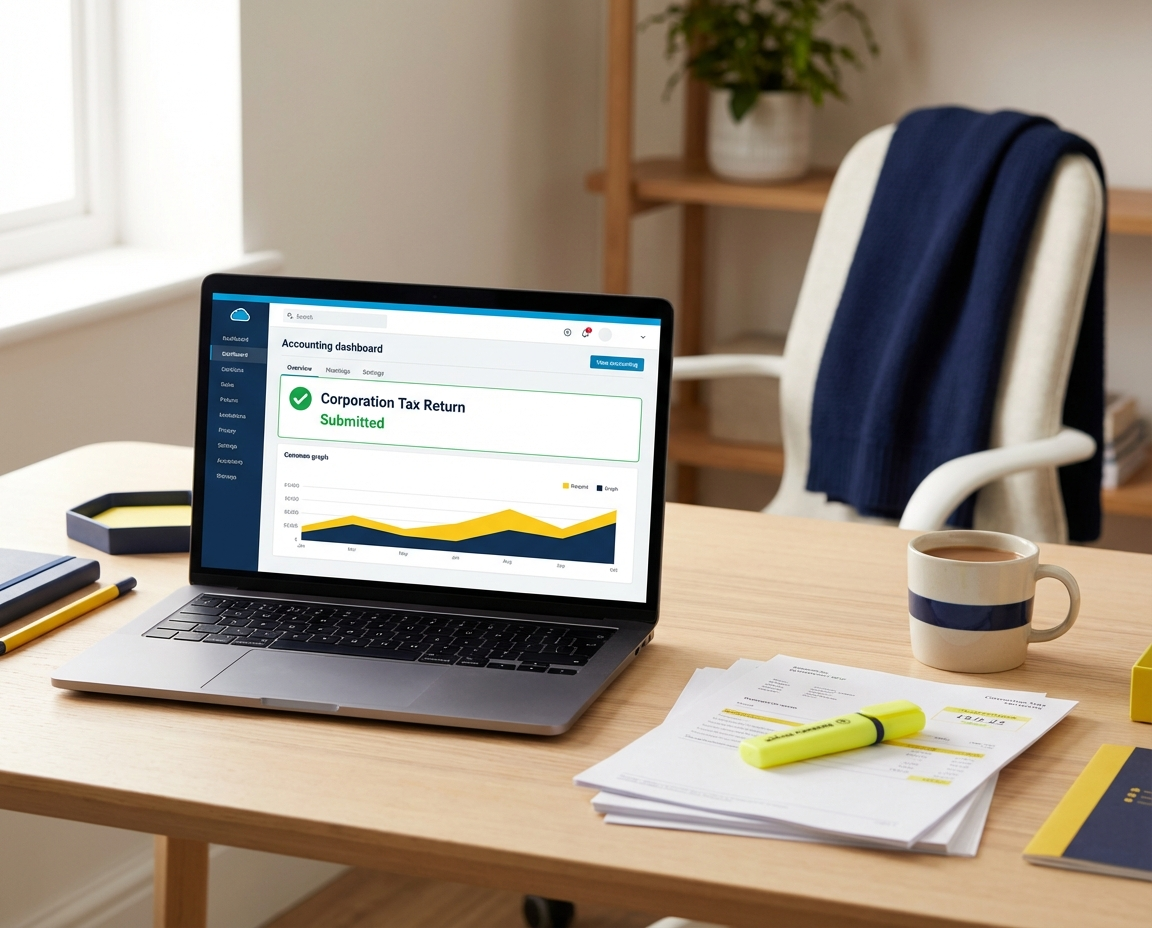
What is a corporation tax return, and do you actually need to worry about it? If you run a limited company in the UK, the short answer is yes, and this article will explain exactly what it involves without the jargon.
What a Corporation Tax Return Actually Is
A corporation tax return is the formal document you submit to HMRC to report your company’s profit for the year and calculate how much Corporation Tax is owed. It’s filed using a form called the CT600, along with your company accounts and a tax computation. Think of it as HMRC asking: ‘What did your company earn, what did it spend, and how much tax does it owe?’
It’s worth being clear upfront: this is different from your Companies House accounts, your self assessment return, and any payroll submissions. They’re all separate obligations. The corporation tax return is specifically about your company’s taxable profits, and HMRC requires every active limited company to file one even if the company made a loss or no profit at all.
Even if your company made no profit, you still need to file a corporation tax return. A dormant company has its own rules, but any company that traded during the year needs to submit one regardless of the result.
When Is It Due and What Are the Deadlines?
There are actually two separate deadlines to track here. Your corporation tax payment is due 9 months and 1 day after the end of your accounting period. Your CT600 return itself has to be filed within 12 months of the end of the accounting period. So if your company year ends on 31 March 2026, your tax bill is due by 1 January 2027, and your return must be filed by 31 March 2027.
Missing either deadline has real consequences. HMRC increased its fixed late filing penalties for returns with a filing date on or after 1 April 2026, partly to account for inflation since the original penalties were set. The current penalty structure runs like this: £100 for being 1 day late, another £100 at 3 months, 10% of the unpaid tax at 6 months late, and another 10% at 12 months. It adds up quickly if you let it drift.
What Actually Goes Into the CT600 Form?
The CT600 pulls together your company’s income, allowable deductions, reliefs you’re entitled to claim, and the final tax calculation. HMRC’s guidance on completing the CT600 covers how to report each of these elements, but in practice you’re essentially reconciling your accounting profit with your taxable profit, because those two figures are often different. Capital allowances, for example, replace accounting depreciation in the tax computation.
The rate of Corporation Tax you pay depends on your profit level. Companies with profits up to £50,000 pay 19%. Above £250,000 the rate is 25%. If you fall in between those two figures, the effective marginal rate is 26.5% on the profits in that band, which catches a lot of small but growing businesses by surprise. Getting the computation right and claiming every relief you’re entitled to genuinely matters at those rates.
Common Mistakes That Catch Directors Out
The most common errors I see are: using the wrong accounting period dates on the CT600, forgetting to claim capital allowances on equipment purchases, and including expenses that HMRC doesn’t allow, like client entertainment or fines. That last one tends to trigger HMRC adjustments and, sometimes, penalties on top. It’s not that directors are cutting corners, it’s that most people running a business haven’t sat down and read the rules on disallowed expenditure.
Director salary and dividend treatment is another area where mistakes creep in. Getting those wrong doesn’t just affect the corporation tax return, it can create issues with your payroll and your personal self assessment too. HMRC is also consulting on prescribing more standardised formats and XBRL data tagging for CT computations from 2026 onwards, so the expectations around accuracy are only likely to increase. If you’re unsure whether your return is correct, it’s worth getting a second pair of eyes on it before you file.
Corporation tax returns aren’t the most exciting part of running a company, I’ll grant you that. But getting them filed correctly and on time means one less thing keeping you up at night. If you’d like to talk through where your company stands, just book a free call and I’ll give you a straight answer.
Want to go further?
Whether you want a full walkthrough of how to file, or you’d rather hand it over and have it done for you, both options are here.
Not sure where you stand with your corporation tax return?
Answer five quick questions and find out what you need to do next and whether your deadline is closer than you think.

AAT qualified accountant based in Uttoxeter. Personal, one-to-one accounting for small businesses and sole traders across the UK.