Limited company accounts explained in plain English
“Luke is an extremely professional and approachable guy. His knowledge in the field of accounting is second to none.”
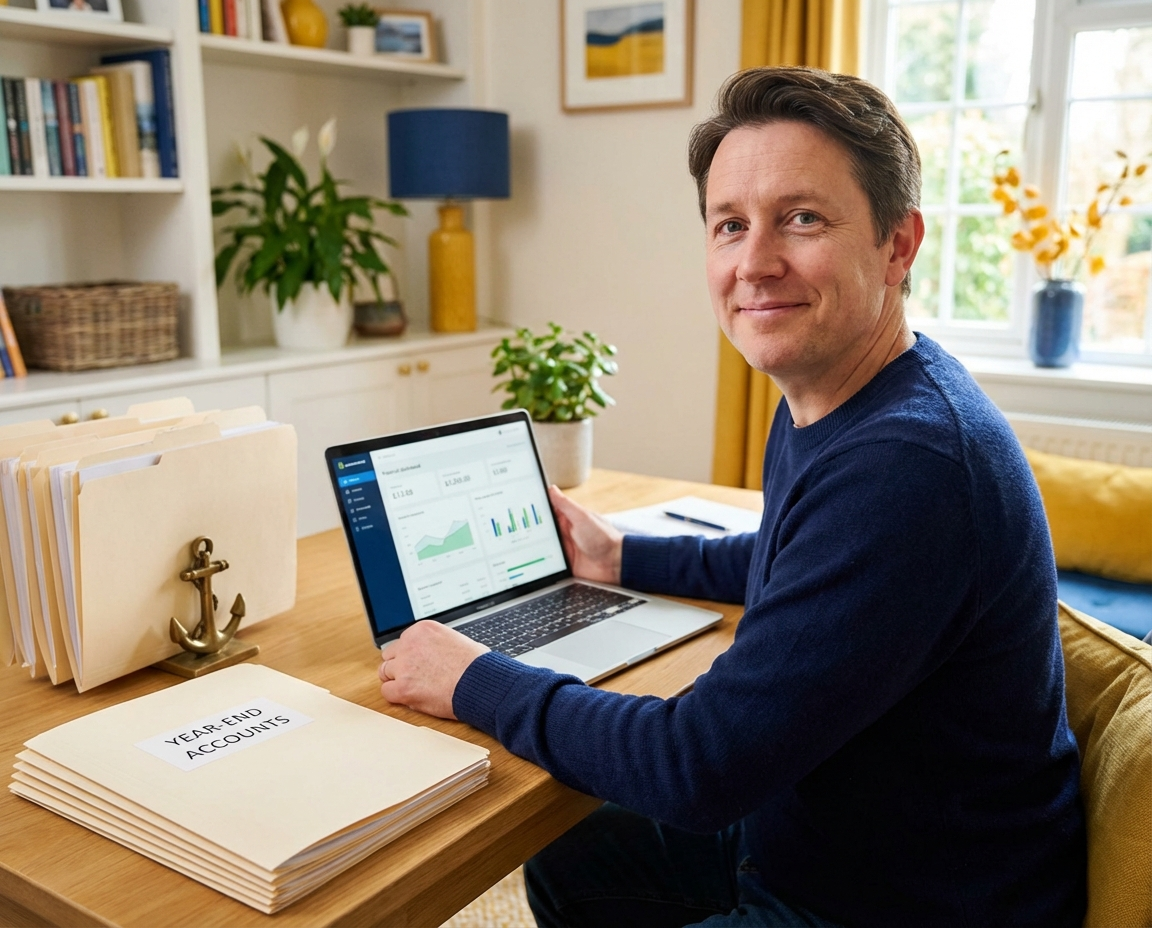
What are limited company accounts, exactly? If you’ve just had a reminder from Companies House and you’re not entirely sure what you’re supposed to do about it, this is written for you.
What limited company accounts actually are
Limited company accounts are a formal summary of your company’s financial activity over the year. They show what the company earned, what it spent, what it owns and what it owes. They are not just for you. They are a legal requirement, and two separate organisations want to see them.
First, Companies House requires you to file a set of statutory accounts every year. These become part of the public record, so anyone can look them up. Second, HMRC needs the same financial data to calculate your Corporation Tax bill. Both deadlines are real, and both carry penalties if you miss them.
Your limited company accounts and the Corporation Tax return are two separate filings. They go to different places on different deadlines. Missing either one can trigger a fine or a tax surcharge.
What you actually need to file, and when
There are three things most small limited companies file each year: statutory accounts to Companies House, a Corporation Tax return (CT600) to HMRC, and a Confirmation Statement to Companies House confirming your company details are up to date. The accounts and the CT600 cover the same financial period but land with different organisations on different timelines.
For most private limited companies, you have nine months from the end of your accounting period to file accounts with Companies House. Your Corporation Tax return goes to HMRC within 12 months of the same period end. Your first set of accounts as a newly incorporated company has a slightly different deadline, so it is worth checking your specific dates on the Companies House portal rather than assuming.
Do you actually need an accountant for limited company accounts?
Technically, no. You can prepare and file your own accounts. In practice, most directors find it harder than expected, particularly once Corporation Tax, director salary calculations, dividends and allowable expenses come into the picture. A mistake in the accounts does not just affect your Companies House filing. It can mean you pay the wrong amount of tax, or miss a deduction you were entitled to.
The question I hear most often is whether accountant fees are worth it. Accountancy fees for limited companies are a tax-deductible company expense, which means the real cost is lower than the invoice. As of 2025, 44% of UK limited companies are run by a single director with no other employees. Those are the businesses that tend to feel the admin most sharply, because there is nobody else to hand it to.
What happens if you miss a filing deadline?
Late filing penalties are automatic. Companies House does not send a warning first. The penalty starts at £150 for being up to one month late and increases from there. If your accounts are consistently late, the penalty doubles on the second offence in a five-year period.
The bigger risk is not the fine itself. It is the knock-on effect. Late accounts can flag your company to HMRC for a tax enquiry, damage your credit profile and, in some cases, lead to a director disqualification investigation if it becomes a pattern. None of that happens to directors who file on time. It sounds obvious, but a surprising number of small company directors only discover the deadline has passed when the penalty letter arrives.
Running a limited company brings real administrative responsibility, and accounts are at the centre of it. But once you understand what is actually required, it is far less intimidating than it looks on the first search. If you want to talk through your situation before committing to anything, just drop me a message at /contact and I’ll get back to you the same day.
Ready to go further?
Here are two useful next steps depending on where you are right now.
Not sure where your limited company accounts stand?
Answer five quick questions and find out what you need to focus on before your next filing deadline.

AAT qualified accountant based in Uttoxeter. Personal, one-to-one accounting for small businesses and sole traders across the UK.