A Plain-English Guide to Bookkeeping in Stoke-on-Trent
“Would 100% recommend, is always polite, professional and helpful! He is always available to answer any questions I have and his knowledge has been a saving grace many times!”
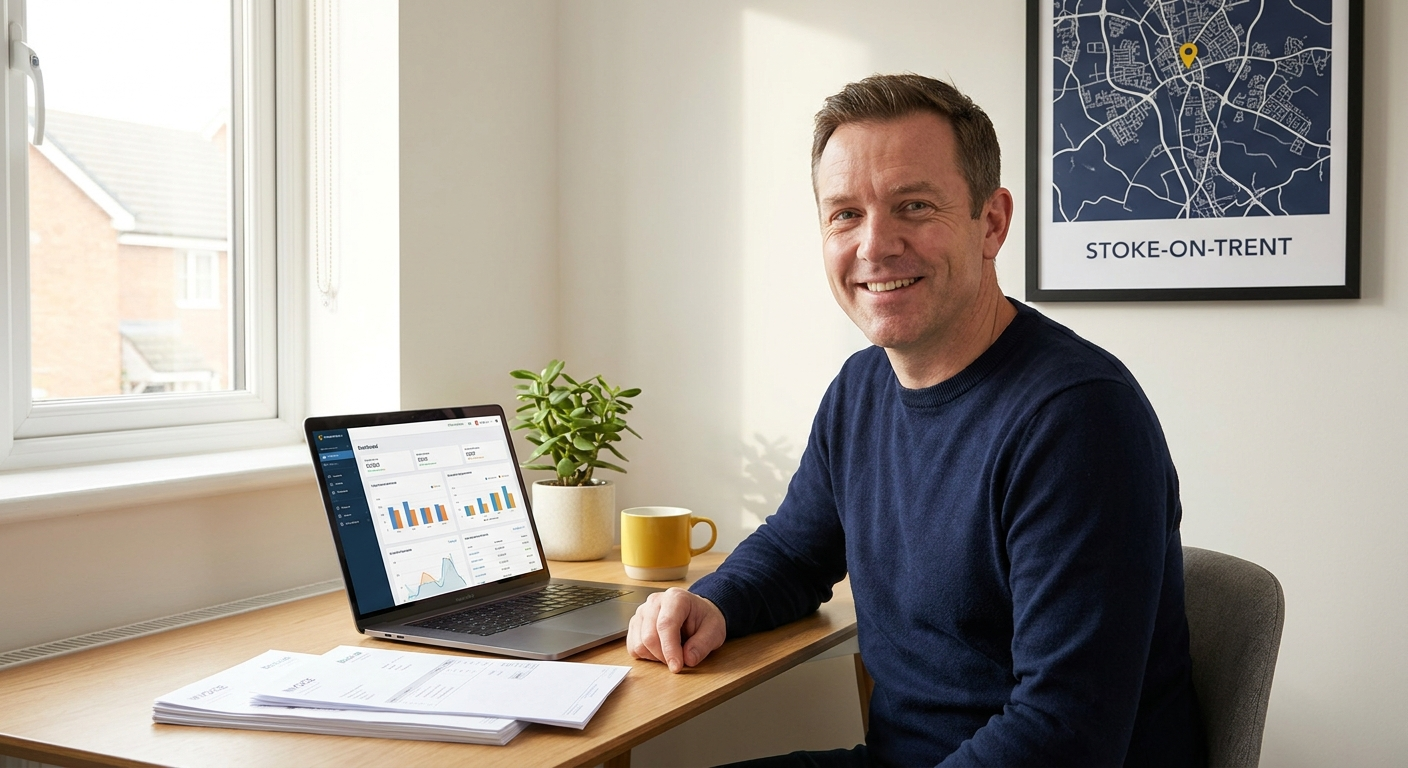
Most small business owners in Stoke-on-Trent are keeping their books themselves, quietly hoping nothing goes wrong. This guide covers what you actually need to record, where the common mistakes happen, and how to keep HMRC off your back without turning bookkeeping into a second job.
Why bookkeeping matters for Stoke-on-Trent businesses
Stoke-on-Trent has an active and growing small business community. In March 2026, local bookkeeping firm Drive Ahead Bookkeeping expanded its team and upgraded its facilities with funding from BCRS Business Loans, which signals genuine demand for bookkeeping support across the city. If businesses around you are investing in professional books, the competitive and compliance pressure to do the same is real.
For limited companies specifically, UK law requires you to keep detailed accounting records including all money received and spent, assets, debts, stock, and goods bought or sold. Those records must be held for at least six years from the end of the financial year they relate to. Failing to keep them can result in a fine of up to £3,000 or disqualification as a director.
Under UK law, limited companies must retain accounting records for at least 6 years. Sole traders must keep self-assessment records for at least 5 years after the 31 January submission deadline. Getting behind on your books does not pause these obligations.
Where most Stoke business owners go wrong
The most costly bookkeeping mistakes are rarely dramatic. They are usually small, repeated errors that compound quietly until a deadline or an HMRC query forces them into the open. Common SME bookkeeping pitfalls include duplicate charges and missing receipts, both of which distort your profit figures and inflate your tax bill or, in the other direction, create claims you cannot evidence.
Mixing personal and business finances
Running business transactions through a personal account is one of the single most common errors I see. It creates hours of untangling work at year-end and makes it near-impossible to prove legitimate business expenses to HMRC. UK law requires limited companies to keep business finances entirely separate from personal finances, and the same discipline applies practically to sole traders too.
Letting records fall months behind
Bookkeeping done in real time takes minutes per week. Bookkeeping done six months late takes days and requires you to reconstruct context you have forgotten. Cloud platforms like QuickBooks Online and Xero make real-time financial reporting accessible to small businesses in 2026, with automated bank feeds that pull transactions in daily. The technology is not the barrier; the habit is.
“Most clients who come to me have not let things get catastrophically wrong. They have just let them drift for a few months and now the thought of opening the accounts feels worse than it actually is. Once we get the backlog sorted, keeping up is genuinely straightforward.”
What to do, step by step
Getting your bookkeeping under control does not require a background in finance. It requires a consistent process and the right tools. Here is a straightforward approach that works for sole traders and limited companies in Stoke-on-Trent.
- Open a dedicated business bank account and route every business transaction through it. This is a legal requirement for limited companies and the single most useful habit for sole traders. It creates a clean record that any accountant, or HMRC inspector, can follow without confusion.
- Choose a cloud accounting platform and connect your bank feed. QuickBooks, FreeAgent, Xero, and Sage all support automated bank feeds that import your transactions daily. Once connected, categorising income and expenditure takes a few minutes each week rather than hours each quarter.
- Set a fixed time each week to review and categorise transactions, file receipts digitally, and flag anything you are unsure about. Weekly reconciliation means your figures are accurate in real time and your year-end or VAT return is never a crisis. If you are VAT registered, Making Tax Digital (MTD) already requires compatible software, so this step is not optional.
If you are already behind, the priority is to get the most recent period accurate first and work backwards. Attempting to start at the beginning of a messy period and reconstruct everything chronologically is usually slower and more demoralising than it needs to be.
Costs and what to expect
The real cost of bookkeeping is not the monthly fee. It is the time you spend doing it yourself, the errors that go unnoticed until a penalty lands, and the mental load of knowing your records are not quite right. A sole trader spending four hours a month on their own books at a day rate of £200 is already spending £100 in opportunity cost before accounting for the risk of filing errors. Professional bookkeeping from a qualified accountant typically starts from around £50 to £100 per month for simple sole trader records, rising depending on transaction volume, VAT, payroll, and the level of catch-up required.
| Option | Pros | Cons |
|---|---|---|
| DIY bookkeeping | No monthly fee; full visibility of your own numbers | Time-consuming; high risk of categorisation errors, missed claims and HMRC penalties |
| Outsourced to a qualified accountant | Accurate records, deadlines tracked, tax-efficient categorisation, peace of mind | Monthly fee required; requires handing over bank access or transaction exports |
How to get started today
If your books are behind, the first step is a honest audit of where things stand. That does not mean fixing everything at once. It means knowing your oldest unreconciled period, whether your bank feed is connected, and whether you are VAT registered with MTD obligations already in play. From there, you can either work through it yourself using the steps above or hand it to a qualified bookkeeper to sort out on your behalf.
- Log into your accounting software today and check your last reconciled date. If it is more than four weeks ago, schedule two hours this week to catch up and reconnect your bank feed if it has lapsed.
- If you do not have accounting software yet, sign up for a free trial of QuickBooks or FreeAgent, connect your business bank account, and import the last three months of transactions. Both platforms are Making Tax Digital compliant and work for sole traders and limited companies.
Ready to sort your bookkeeping?
I provide monthly and quarterly bookkeeping for sole traders and limited companies, including bank reconciliation, VAT returns, and cloud accounting setup, on a fixed monthly fee with no tie-in. Book a free 20-minute call and we can go through where things stand.
How healthy are your business books right now?
Answer five quick questions and get a clear picture of where your bookkeeping stands and what to do next.

AAT qualified accountant based in Uttoxeter. Personal, one-to-one accounting for small businesses and sole traders across the UK.