A No-Nonsense Guide to Accounting for Builders
“Would 100% recommend, is always polite, professional and helpful! He is always available to answer any questions I have and his knowledge has been a saving grace many times!”
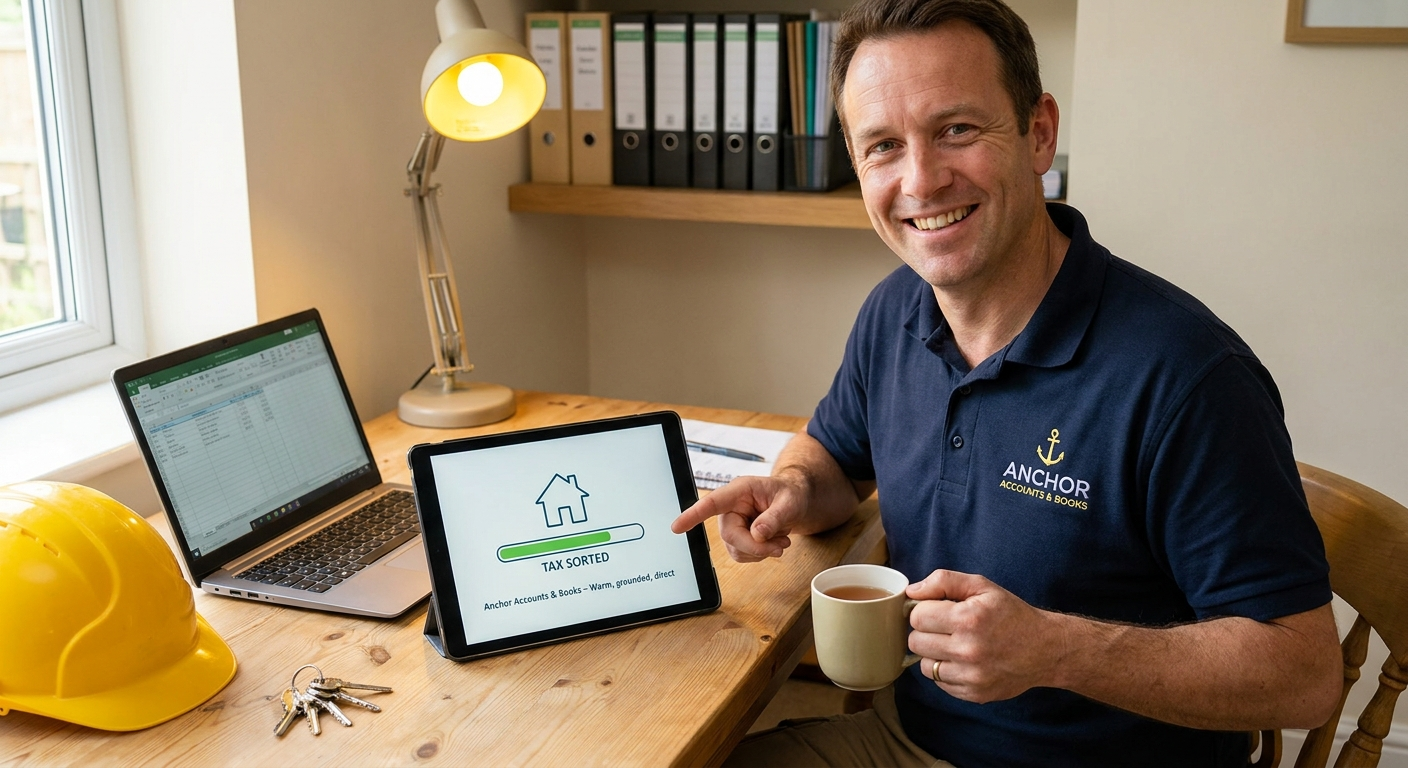
If your current accountant once asked you what retention means, you already know the problem. This guide covers the tax obligations, common errors and practical steps that matter specifically to builders working in the UK.
Why accounting for builders is not the same as accounting for everyone else
Building work creates financial patterns that most accountants simply do not see with other clients. Staged payments, retention held by clients for months, subcontractors paid under CIS, and VAT that changes rate depending on whether a property is new-build or a renovation — these are not edge cases in construction. They are the daily reality.
Construction new orders grew by 5.6% in 2024 to over 71 billion pounds, yet the industry continues to see high rates of business failure. Cash flow timing, not lack of work, is frequently the cause. Getting the accounting right is not an administrative task — it is a survival skill.
HMRC is actively working to simplify the Construction Industry Scheme but has also flagged fraud risks within it. Proposed CIS amendments include reinstating nil reporting requirements for contractors. If you pay subcontractors, you already have CIS obligations whether you have registered deliberately or not.
Where builders most often get it wrong
The mistakes that cause real financial pain for builders are not usually dramatic. They tend to be quiet, repeating errors that compound over years — wrong VAT rates applied to mixed-rate jobs, CIS deductions handled inconsistently, or job costs tracked loosely enough that you genuinely cannot tell whether a contract made money.
Getting VAT wrong on construction work
VAT on building work is not straightforward. New residential builds can qualify for the zero rate. Renovations, extensions and commercial work are generally standard-rated at 20%. Applying the wrong rate — in either direction — creates problems: you either charge a client incorrectly or under-declare output VAT to HMRC. If you do any new-build or conversion work alongside standard-rated projects, how you handle VAT and CIS on the same invoice matters and is worth getting confirmed in writing before you raise it.
Treating CIS as someone else’s problem
If you pay subcontractors directly, you are a contractor under CIS and you are responsible for verifying their status with HMRC and deducting the correct amount. Many builders either skip the verification step or deduct inconsistently across a project. HMRC has noted ongoing compliance concerns within the scheme and continues to target underpayments. The liability for getting it wrong sits with you, not the subcontractor.
“Most builders I work with are not in trouble because they failed to pay tax. They are in trouble because nobody ever sat down with them and explained what they owed and when. That is a fixable problem.”
What to do with your accounts as a builder, step by step
There is no single moment when you need to get your accounting in order. There are several. Each one below represents a point where builders typically have either too little information or the wrong setup entirely.
- Register correctly with HMRC from the start. If you pay subbies, register as a CIS contractor. If you are being paid and have deductions taken from your invoices, register as a CIS subcontractor. These are separate registrations and the deductions you suffer as a subcontractor can be offset against your tax bill — but only if they are tracked properly from the first payment.
- Set up a bookkeeping system that separates jobs. A single bank account and a spreadsheet will not tell you which jobs made money. Use cloud software — QuickBooks, FreeAgent or Xero all allow you to tag income and costs by project. That separation is what makes job costing possible. Without it, your profit figure is a guess.
- File and pay on time across every obligation you carry. As a builder you may have self assessment (if sole trader), corporation tax (if limited), VAT returns under Making Tax Digital, monthly or quarterly CIS returns as a contractor, and payroll submissions if you employ anyone directly. Missing any one of these generates a penalty. Tracking them together, not separately, is the only way to stay on top.
From April 2026, builders using labour supply chains that include umbrella companies face additional PAYE obligations. New rules mean the agency or end client can be held responsible for PAYE underpayments if an umbrella company fails to operate it correctly. If you use umbrella workers on site, you need to know where liability sits before the next payment run.
Costs and what to expect
Accounting fees for builders vary depending on how the business is structured and how much ongoing support is involved. A sole trader with straightforward accounts and a single self assessment return will pay less than a limited company with payroll, quarterly VAT, CIS contractor submissions and monthly bookkeeping. The honest question is not whether you can afford proper accounting — it is what the annual cost of errors, late penalties and missed tax planning is costing you already.
| Option | Pros | Cons |
|---|---|---|
| DIY accounting | No monthly fee | High risk of CIS errors, wrong VAT rates and missed deadlines that carry HMRC penalties |
| Using a specialist accountant | Correct CIS and VAT handling, deadlines tracked, accurate tax position known year-round | Monthly or annual fee, takes a short onboarding period to get set up |
How to get started today
The first step does not require you to have everything in order. Most builders who come to me have some combination of incomplete records, a system that sort of works and a nagging sense that something has been handled wrong somewhere. That is a normal starting point, not a problem.
- Pull together three months of bank statements and any CIS deduction statements you have received. That is enough to start a conversation about where your tax position actually stands.
- Book a free call at /contact. There is no commitment attached to it. I will ask you a few direct questions about your setup — sole trader or limited, whether you take on subbies, whether you are VAT registered — and tell you plainly what needs sorting and what it would cost.
Ready to sort your builder accounts?
I offer fixed monthly fees covering CIS returns, VAT, self assessment and bookkeeping for sole traders and limited companies in construction — with no tie-in and no junior staff handling your work. Book a free 20-minute call and I will tell you exactly what your setup needs.
Is your builder accounting actually working for you?
Answer five quick questions and get a clear picture of where your tax and compliance setup has gaps.

AAT qualified accountant based in Uttoxeter. Personal, one-to-one accounting for small businesses and sole traders across the UK.